English
  日本語
日本語  한국어
한국어  français
  Deutsch
  Español
  italiano
  русский
  العربية
  Türkçe
  tiếng việt
Feb 24, 2026
Polyurethane (PU) is the most widely used material for AGV drive wheels because it balances traction, wear resistance, noise control, and floor protection. Rubber offers superior grip and vibration absorption in demanding environments, while nylon provides high load capacity and low rolling resistance on smooth, controlled floors. Each material serves a distinct operational purpose, and selecting the wrong one often leads to premature wear, positioning errors, or increased maintenance costs.
Below is an industry-focused comparison based on real AGV operating conditions.
AGV drive wheels are continuously exposed to dynamic loads, frequent start-stop cycles, and precise positioning requirements. Wheel material directly affects:
Traction and slip behavior
Encoder accuracy and navigation stability
Floor wear and noise levels
Wheel lifespan and maintenance intervals
Material choice is therefore a system-level decision, not a cosmetic one.
PU combines the elasticity of rubber with the durability of plastic, making it suitable for most indoor AGV environments.
Excellent wear resistance under continuous operation
Stable friction coefficient for accurate motion control
Low noise and vibration
Minimal floor damage on concrete and epoxy surfaces
Warehouse and logistics AGVs
Pallet transport vehicles
AMRs operating on polished concrete
PU wheels are often the default choice where balanced performance and long service life are required.
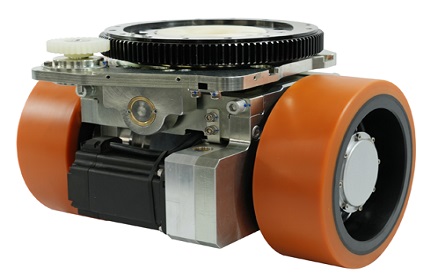
Rubber is preferred when maximum traction and shock absorption are critical, particularly on uneven or slippery floors.
High grip, even on dusty or slightly wet surfaces
Excellent vibration damping
Reduced slip during acceleration and braking
Faster wear compared to PU
Higher rolling resistance
Potential for marking certain floor types
Outdoor or semi-outdoor AGVs
Sloped floors or ramps
AGV heavy-load with frequent stopping
Rubber wheels are selected when traction reliability outweighs wear considerations.
Nylon is suitable in specific, controlled environments where floors are smooth and loads are high.
High load-bearing capacity
Very low rolling resistance
Excellent chemical resistance
Low traction compared to PU and rubber
Higher noise levels
Increased risk of slip on smooth or dusty floors
Cleanrooms
Lightweight AGVs with constant-speed travel
Specialized industrial environments
Nylon wheels are rarely used as primary drive wheels in dynamic AGV automated guided vehicle systems but can perform well under stable, predictable conditions.
Wheel material influences micro-slip behavior, which directly affects encoder feedback and positioning accuracy.
PU provides consistent friction, supporting stable encoder readings
Rubber may introduce slight deformation under load, requiring tuning
Nylon can slip more easily, increasing correction frequency
For high-precision AGVs, material consistency is as important as motor and encoder quality.
PU wheels are generally the best choice for concrete floors due to their balance of traction, durability, and floor protection. Rubber may be used where additional grip is required, while nylon should be limited to smooth, sealed concrete surfaces.
| Property | PU | Rubber | Nylon |
Traction | High | Very High | Low |
Wear resistance | Excellent | Moderate | Excellent |
Noise level | Low | Low | High |
Floor protection | Very good | Good | Poor |
Load capacity | High | High | Very high |
Typical AGV use | Primary drive wheel | High-traction needs | Special conditions |
Not necessarily. Excessively soft materials can deform under load, affecting control accuracy and increasing energy consumption.
Yes. Many AGVs use PU drive wheels with nylon or rubber support wheels to optimize performance and cost.
PU typically offers the longest service intervals, rubber requires more frequent replacement, and nylon needs close monitoring for slip-related issues.
In practice, most performance issues we see in the field are not caused by motor or controller failures, but by incorrect wheel material selection. A mismatch between floor condition, load profile, and wheel material leads to unstable navigation and unnecessary downtime.
At hagvwheel.com, we evaluate operating environments before recommending PU, rubber, or nylon solutions—often customizing tread hardness and compound formulation to match specific duty cycles.
Choosing the right AGV drive wheel material is one of the most effective ways to improve system reliability, reduce maintenance costs, and protect both vehicles and floors over the long term.