English
  日本語
日本語  한국어
한국어  français
  Deutsch
  Español
  italiano
  русский
  العربية
  Türkçe
  tiếng việt
Sep 04, 2026
Heavy duty robot wheels directly affect the safety, positioning accuracy, operating efficiency, and service life of warehouse AGVs and mobile robots. When an automated vehicle carries pallets, machinery, or other high-value loads, its wheels must do more than support the weight. They must deliver consistent traction, withstand repeated acceleration and braking, and maintain stable contact with the floor.
An incorrectly specified drive wheel can cause slipping, route deviation, excessive power consumption, premature tire wear, and unplanned downtime. For this reason, selecting the correct robot drive wheels should be treated as a core system-engineering decision rather than a minor mechanical detail.
Heavy-duty wheel systems from HAGVWheel are designed for industrial applications with load requirements ranging from approximately 500 kg to 25 tons, using polyurethane or rubber tires for different operating conditions.
A wheel’s nominal load rating is only part of the calculation. Automated warehouse vehicles experience changing forces during acceleration, braking, turning, docking, and ramp travel.
The load is also rarely distributed equally across every wheel. Floor irregularities, vehicle geometry, payload position, and suspension movement can temporarily place additional pressure on one drive unit.
Heavy duty AGV drive wheels are designed to handle these dynamic conditions more reliably. A properly selected wheel assembly helps:
Reduce excessive tire deformation
Maintain stable vehicle height
Protect bearings, gearboxes, and motor components
Improve braking consistency
Prevent wheel overload during turns or emergency stops
The wheel rating should therefore be calculated according to the vehicle’s maximum loaded weight, actual wheel distribution, dynamic operating conditions, and an appropriate safety margin.
The navigation system may calculate the route, but the wheels determine how accurately the vehicle follows it.
Many AGVs use wheel encoders to estimate travel distance and turning angle. When a drive wheel slips, deforms inconsistently, or loses contact with the floor, the encoder may report wheel rotation that does not match the vehicle’s actual movement. This can lead to positioning errors, repeated route corrections, and inaccurate docking.
Consistent wheel diameter, reliable traction, controlled tread deformation, and balanced left-right wheel performance are especially important for differential-drive AGVs. Differences in wheel speed or floor friction can be amplified during steering, particularly under heavy loads.
High-quality robot drive wheels help maintain predictable contact with the floor, supporting more stable encoder feedback and repeatable vehicle movement.
Polyurethane is generally the preferred material for indoor warehouse AGVs because it offers a practical balance of load capacity, traction, wear resistance, low noise, and floor protection.
Polyurethane wheels are suitable for most warehouses with smooth concrete, sealed concrete, epoxy, or tiled floors. Their main advantages include:
High wear resistance
Stable rolling characteristics
Low operating noise
Good floor protection
Lower rolling resistance than many soft rubber compounds
These characteristics make polyurethane a strong choice for high-frequency pallet transport, production-line delivery, and continuous warehouse logistics.
Rubber wheels are more suitable when additional grip and vibration absorption are required. Typical conditions include uneven floors, ramps, expansion joints, dusty routes, and areas where the vehicle performs frequent acceleration or braking.
Rubber usually provides better cushioning and traction but may have higher rolling resistance and a shorter service life than polyurethane.
Material selection should be based on the real floor condition and duty cycle rather than load capacity alone.
Correctly matched AGV drive wheels can improve energy efficiency by reducing unnecessary rolling resistance, wheel slip, and repeated steering corrections.
However, choosing the hardest available wheel is not always the best solution. A very hard tread may roll efficiently but provide insufficient grip on dusty or polished floors. An excessively soft tread may improve traction but deform more under load, increasing energy consumption and heat generation.
The best wheel provides enough traction for acceleration, braking, and steering while maintaining controlled deformation under the maximum payload. Wheel diameter, tread hardness, motor torque, gearbox ratio, travel speed, and floor condition must be evaluated together.
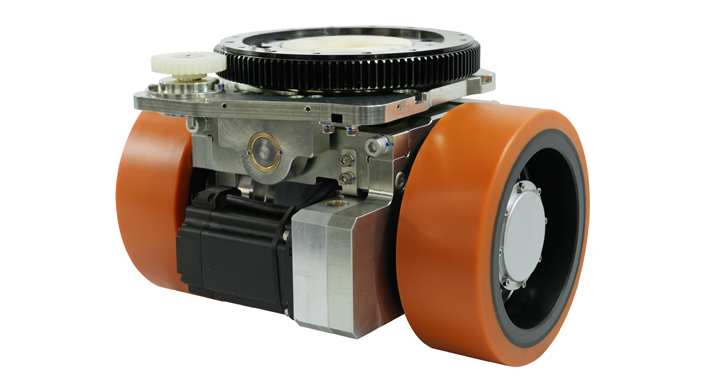
Wheel-related problems often develop gradually. Tread wear, tire separation, bearing damage, uneven loading, and reduced traction may first appear as small navigation corrections or unusual noise before causing a vehicle stoppage.
Heavy duty wheel assemblies help extend maintenance intervals when they are correctly matched to the application. They also reduce secondary stress on motors, gearboxes, bearings, brakes, and vehicle frames.
Warehouse operators should include the following items in preventive maintenance inspections:
Tread wear and uneven wheel diameter
Cracks, cuts, flat spots, or tire separation
Bearing noise and excessive play
Abnormal heat after continuous operation
Reduced traction during acceleration or braking
Loose mounting bolts
Changes in docking or positioning accuracy
Replacing a worn wheel before it fails is significantly less disruptive than recovering a stopped AGV carrying a heavy load in an active warehouse aisle.
The selection process should begin with the complete operating profile, not only the motor power or vehicle payload.
Key information includes:
Maximum vehicle and payload weight
Number and arrangement of load-bearing wheels
Static and dynamic load per wheel
Required travel speed and acceleration
Floor material and surface condition
Ramp angle and obstacle-crossing requirements
Daily operating hours and start-stop frequency
Required braking performance
Motor voltage, torque, and gearbox ratio
Mounting space and steering configuration
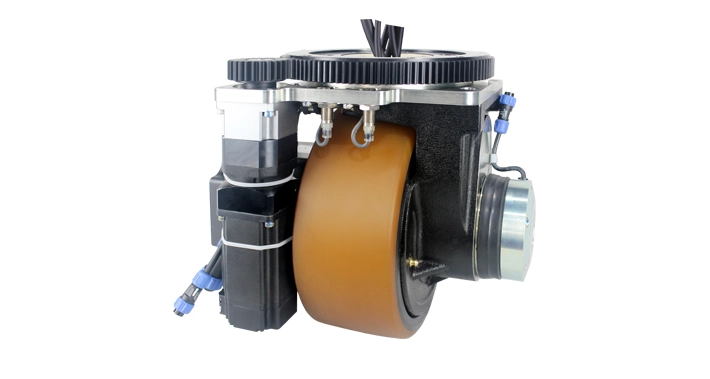
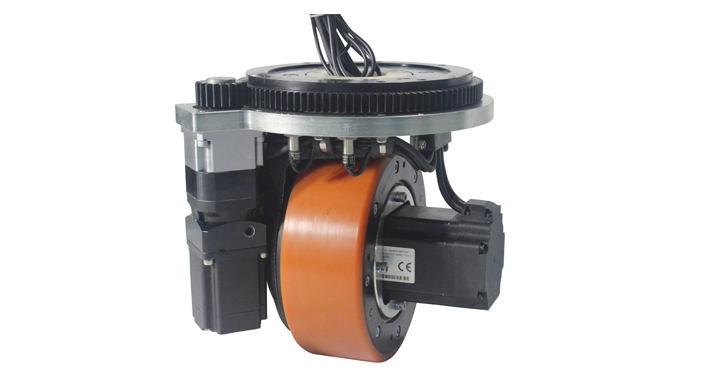
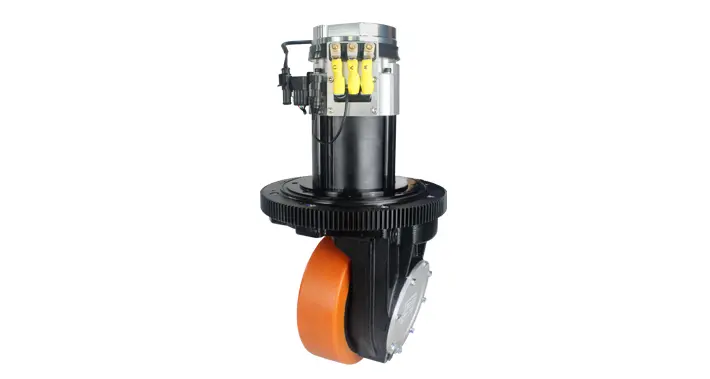
HAGVWheel offers heavy-duty differential steering wheels, double-wheel drive units, horizontal drive wheels, vertical drive wheels, and customized solutions for industrial AGVs. Its product selection guidance also emphasizes static and dynamic load, floor type, operating environment, and compatibility with 24V or 48V drive systems.
For demanding warehouse projects, providing complete application data allows the wheel manufacturer to recommend the correct tread material, hardness, diameter, motor, reduction ratio, brake, and mounting structure.
Heavy duty robot wheels influence nearly every part of AGV performance, from load stability and navigation accuracy to battery consumption and maintenance cost.
The most effective solution is not simply the wheel with the highest load rating. It is a properly engineered drive unit that matches the payload, floor, speed, steering method, duty cycle, and operating environment.
HAGVWheel supplies heavy-duty robot drive wheels and customized AGV drive wheels for automated warehouses, pallet-handling vehicles, industrial forklifts, and high-load mobile robot systems. Providing the vehicle weight, target speed, wheel arrangement, floor condition, motor voltage, and operating schedule can help accelerate technical evaluation and product selection.
The required capacity should be calculated using the maximum loaded vehicle weight, actual load distribution, dynamic forces, and a safety margin. Do not divide the total weight equally by the number of wheels unless the chassis and suspension guarantee equal loading.
Yes, but the system must have sufficient motor torque, traction, braking capacity, and thermal performance. Ramp angle, maximum payload, travel direction, stopping requirements, and floor friction should be evaluated before selection.
There is no universal replacement interval. Wheel life depends on payload, operating hours, floor condition, tread material, acceleration, turning frequency, and maintenance quality. Replacement should be based on tread wear, diameter changes, damage, traction loss, abnormal vibration, and declining positioning accuracy.
Yes. Wheel diameter, tread width, polyurethane hardness, rubber compound, motor power, voltage, gearbox ratio, brake configuration, encoder, mounting interface, and steering structure can be customized for specific AGV and warehouse requirements.
This is the first one.